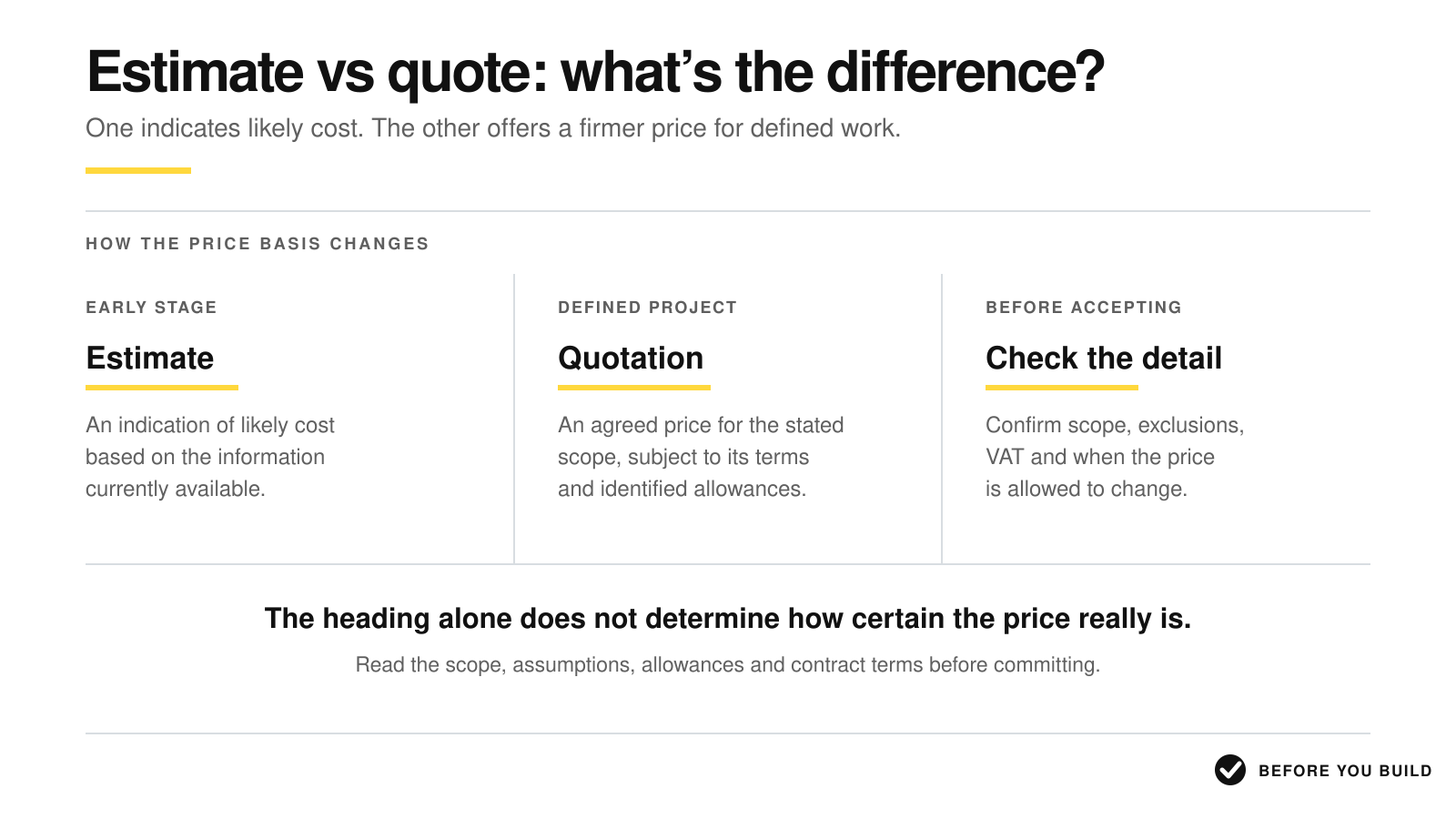
A builder’s estimate is an informed indication of what the work may cost. A builder’s quote—or quotation—is normally an offer to carry out defined work for an agreed price, subject to its stated terms and any permitted adjustments.
The practical difference is cost certainty.
An estimate can change as the design, quantities or site conditions become clearer. A quotation should provide a firmer price for an identified scope, although it can still change if you request extra work, allowances are adjusted or the contract provides another valid basis.
Do not rely only on the heading at the top of the document. Read how the price, scope and possible changes are actually described.
Estimate Versus Quote: The Short Answer
| Estimate | Quote or quotation |
|---|---|
| An indication of likely cost | An offer to undertake defined work for an agreed price |
| May be based on incomplete information | Should be based on a sufficiently identified scope |
| Expected to change as information develops | Intended to remain fixed for the agreed scope, subject to its terms |
| Useful for early budgeting | More suitable for contractor appointment |
| Should explain its assumptions and uncertainty | Should explain inclusions, exclusions, allowances and permitted adjustments |
The words quote and quotation generally mean the same thing. Different builders use different document titles, so the wording and commercial effect matter more than whether the heading says “quote”, “quotation”, “proposal” or “estimate”.
What Is a Builder’s Estimate?
An estimate is the builder’s assessment of what the work is likely to cost based on the information available at the time.
It may be appropriate where:
- The design is at an early stage
- Structural information is incomplete
- Product specifications have not been chosen
- Quantities cannot yet be measured reliably
- Existing conditions have not been investigated
- Specialist subcontractor prices are unavailable
- The homeowner needs an initial feasibility budget
An estimate may be presented as:
- A single approximate figure
- A cost range
- A price per square metre
- A schedule of estimated work sections
- A budget based on stated assumptions
A useful estimate should explain the information used, the level of design development, major assumptions, exclusions, VAT treatment and how long the pricing basis is expected to remain relevant.
The word “estimate” should not be treated as permission for an unlimited or unexplained increase. It means the price has less certainty, not that the homeowner has agreed to pay any amount later demanded.
What Is a Builder’s Quote?
A quote is normally an offer to complete identified work for an agreed price.
It should state clearly:
- Who is offering to carry out the work
- Which property and project it covers
- Which drawings and specifications were priced
- The work and materials included
- Important exclusions
- PC sums, provisional sums and other allowances
- Whether VAT is included
- The total price
- How long the offer remains valid
- Circumstances in which the price may change
- Payment and other commercial terms
Citizens Advice describes a quote as a fixed price and recommends obtaining it in writing. Business Companion similarly explains that a quotation is normally a fixed price, while an estimate is generally a rough indication of cost.
In building work, “fixed” must still be read against the agreed scope and contract. A fixed quotation for a defined extension does not automatically include later design changes, additional work or the final value of clearly identified adjustable allowances.
Is a Quotation the Same as a Fixed Price?
Usually, a quotation is intended to provide a fixed price for the work it defines. However, the complete document may contain both fixed and adjustable elements.
For example:
| Price component | Amount | Cost status |
|---|---|---|
| Defined construction work | £88,000 | Fixed for the stated scope |
| PC sum for tiles | £4,000 | Adjustable when tiles are selected |
| Provisional sum for drainage | £6,000 | Adjustable when work is defined |
| Quotation total excluding VAT | £98,000 | Includes £10,000 of allowances |
The document can still be a quotation, but not every pound within the total carries the same certainty.
Before accepting it, separate fixed work from allowances and understand how each adjustable amount will be calculated.
Is a Budget Price the Same as an Estimate?
A budget price is usually an early indication used to test affordability or guide design decisions. It often operates like an estimate, but there is no universal meaning.
A budget price might be based on:
- Floor area
- Previous similar projects
- Broad work sections
- An early drawing package
- Assumed specification levels
- Current rates with a general risk allowance
Ask the builder to state whether the budget is:
- A broad feasibility figure
- An estimated range
- A detailed estimate
- Intended to become a quotation after further information
Do not appoint a builder or set the final project budget using an early budget figure without confirming what remains unpriced.
Why the Document Title Is Not Enough
A document headed Quotation might still contain wording that makes the total highly adjustable. An Estimate might contain certain sections that have been firmly priced.
Look for phrases such as:
- Estimate only
- Budget estimate
- Guide price
- Subject to survey
- Subject to remeasurement
- Subject to final design
- Prices to be confirmed
- Rates subject to change
- Materials charged at cost
- Labour charged by the day
- Final price after opening up
- Excludes unforeseen work
- Fixed price for the stated scope
- Valid for 30 days
Read these statements together with the scope, exclusions, allowances and proposed contract.
If the document’s heading and its detailed wording conflict, ask the builder to clarify the intended price basis and issue a revised document.
When Is an Estimate Appropriate?
An estimate can be useful during project development.
It may help you:
- Decide whether a project is broadly affordable
- Compare design options
- Set an initial funding target
- Identify major cost drivers
- Decide which specifications need further work
- Establish whether professional design should continue
An early estimate should not be forced into false precision. If the builder has only planning drawings and a brief conversation, a tightly stated figure may look reassuring without being dependable.
The estimate becomes more useful when its uncertainty is visible. A range of £140,000–£165,000 with clear assumptions may be more honest than an unsupported figure of £147,250.
When Should You Ask for a Quotation?
Before appointing a builder for substantial work, you should normally seek a written quotation based on sufficiently developed information.
This may require:
- Coordinated architectural drawings
- Structural design information
- A clear schedule of work
- Product and finish specifications
- Kitchen and bathroom layouts
- Electrical and heating requirements
- Window and door schedules
- Relevant surveys
- Clear client-supply responsibilities
Not every uncertainty can be eliminated, particularly in an older building. Remaining uncertainties should be identified through exclusions, provisional sums, PC sums or clearly stated assumptions rather than hidden within vague wording.
A quotation should provide a sound basis for comparing builders and forming the written contract.
What Should an Estimate Include?
Even though an estimate is not a fixed quotation, it should still be understandable.
Look for:
- The builder’s correct business details
- Project address and description
- Date of the estimate
- Documents and information reviewed
- Scope assumed
- Specification level assumed
- Estimated amount or range
- VAT position
- Major exclusions
- Important risks and unknowns
- Relevant price date
- Next information needed
- Proposed route to a firmer quotation
If the estimate is a range, ask what separates the lower and upper figures. The answer might relate to specification, structural solutions, ground conditions, access or the extent of existing-property work.
What Should a Quote Include?
A builder’s quote should normally provide greater detail and certainty.
It should establish:
- The correct contracting party
- The project documents priced
- Detailed inclusions
- Relevant products and specifications
- Work expected from the homeowner or others
- Exclusions
- Fixed-price sections
- Allowances and provisional sums
- VAT treatment
- Total amount payable
- Programme assumptions
- Deposit and payment schedule
- Variation procedure
- Price-validity period
- Insurance, certification and handover responsibilities
- Proposed contract terms
The detail should be proportionate to the project. A short quote may be adequate for a simple repair; a major extension or renovation needs a much stronger description of scope, responsibilities and commercial terms.
Can a Builder Charge More Than a Quote?
A builder should not simply disregard an agreed quotation because the work became less profitable than expected.
However, the amount payable may legitimately change where:
- You request extra or different work
- The design or specification changes
- A PC sum or provisional sum is adjusted
- Previously excluded work is later instructed
- Concealed conditions require additional work and you agree how it will be dealt with
- The contract contains another applicable price-adjustment mechanism
Citizens Advice explains that a trader cannot charge more than the quoted price merely at will; additional work should be raised and agreed.
For every proposed change, ask for:
- A written description
- The added or reduced price
- VAT treatment
- The effect on the programme
- Your written approval before the work proceeds, wherever practicable
If you dispute an increase, obtain project-specific consumer or legal advice rather than relying on a general online explanation.
Can a Builder Charge More Than an Estimate?
An estimate can increase because it is not normally a fixed price. That does not mean every increase is automatically reasonable or agreed.
The position depends on:
- The estimate’s wording
- The assumptions and information supplied
- What was later agreed
- Whether the scope changed
- Whether the builder warned you about increasing costs
- The contract terms
- The work actually carried out
Where a contract does not determine the price, section 51 of the Consumer Rights Act 2015 provides for a reasonable price to be paid for the service. What is reasonable depends on the particular facts.
If an estimated cost begins to rise, ask the builder to stop and explain the revised forecast before committing further expenditure. Record any agreement in writing.
Worked Example: Estimate Becoming a Quotation
A homeowner is planning a rear extension.
At planning stage, a builder provides this estimate:
| Early estimate | Amount |
|---|---|
| Anticipated construction cost excluding VAT | £110,000–£130,000 |
The estimate assumes standard glazing, no abnormal ground conditions and a mid-range kitchen installation. Structural engineering, detailed electrical layouts and final finishes are unresolved.
After the design is completed, the builder issues a quotation:
| Final quotation position | Amount |
|---|---|
| Defined construction work | £118,000 |
| Provisional sum for drainage | £5,000 |
| PC sum for floor finishes | £4,000 |
| Quotation excluding VAT | £127,000 |
| VAT at 20% | £25,400 |
| Quotation including VAT | £152,400 |
The £127,000 quotation sits within the earlier estimated range before VAT, but £9,000 remains adjustable through the drainage and flooring allowances.
The example shows why the homeowner must compare:
- Like-for-like VAT positions
- The information available at each stage
- Fixed prices and allowances
- Construction price and total project budget
The estimate was useful for feasibility. The later quotation provides the stronger basis for appointment.
Worked Example: A Quote That Is Not Entirely Fixed
A quotation states:
Extension works — £95,000 plus VAT
Further down, it says:
- Electrical work charged at cost
- Kitchen installation to be confirmed
- Groundworks subject to site conditions
- Decoration excluded
- Structural steel subject to final engineer’s design
The £95,000 is labelled as a quotation, but substantial cost remains uncertain.
Before accepting it, the homeowner should ask the builder to:
- Define the electrical scope or provide an allowance
- Price the kitchen installation
- State the groundworks assumption
- Confirm the steelwork included
- Add decoration to the wider project budget
- Explain how changes will be authorised and valued
The label “quotation” does not remove uncertainty created by the detailed wording.
Estimate Versus Quote When Comparing Builders
Do not rank an estimate and a quotation together as though they are equivalent offers.
Suppose:
| Builder | Document | Submitted total |
|---|---|---|
| Builder A | Estimate based on planning drawings | £105,000 |
| Builder B | Detailed quotation based on construction drawings | £122,000 |
Builder A appears £17,000 cheaper, but the documents do not price the project on the same basis.
Builder A’s figure may change when structural details, specifications and subcontractor prices are confirmed. Builder B may have included work and risk that Builder A has not yet assessed.
Before comparing the totals:
- Issue the same information to both builders.
- Ask each to confirm whether the document is an estimate or quotation.
- Identify missing and excluded work.
- Separate fixed prices from allowances.
- Put VAT on the same basis.
- Ask for revised quotations based on the same information.
The cheapest submitted number is not necessarily the cheapest completed project.
Does Accepting a Quote Create a Contract?
It can.
A contract does not always require a formal signature. Acceptance may occur through written or verbal agreement, paying a deposit, fixing a start date or allowing work to begin.
Business Companion explains that agreeing to a quote can constitute acceptance of an offer. Citizens Advice also warns that you may have formed a contract even where nothing was formally signed.
Before accepting a substantial quotation:
- Confirm the final scope and price
- Resolve material questions
- Check the builder’s legal identity and insurance
- Agree the programme and payments
- Review cancellation information where applicable
- Use a suitable written building contract
- Keep the complete agreed document set
A quotation can become part of the contract, but it is not necessarily the only contract document.
Questions to Ask the Builder
Ask the builder to answer these questions in writing:
- Is this document an estimate or a quotation?
- Is the total fixed for the stated scope?
- Which drawings, revisions and specifications have been priced?
- Which assumptions support the figure?
- What work and materials are included?
- What is excluded?
- Does the total include VAT?
- Which amounts are PC sums, provisional sums or estimates?
- What could legitimately change the price?
- How will variations be priced and approved?
- How long is the price valid?
- What further information is required?
- When can a final quotation be issued?
- What payment schedule is proposed?
- Which written contract will apply?
Where the answers change the commercial position, request a revised document rather than relying on a chain of separate messages.
Warning Signs
Clarify the price basis before proceeding if:
- The builder cannot say whether the figure is an estimate or quote
- A quotation is described as “approximate” throughout
- An estimate is presented as a guaranteed final price
- No drawings or specifications are referenced
- Important work is marked “to be confirmed”
- VAT is not addressed
- The document contains numerous low allowances
- Materials will be charged at cost without explaining mark-ups
- Labour will be charged by the day without estimated duration or rates
- The builder can increase the price without a clear reason or approval process
- The document explains increases but not reductions
- Verbal assurances conflict with the written terms
- You are pressured to pay a deposit before questions are resolved
No single phrase proves that the builder is unsuitable. It indicates where the scope, price or contract needs clarification.
Frequently Asked Questions
Is a quote legally binding in the UK?
Accepting a quotation can create a binding contract, depending on what was offered, accepted and agreed. Contracts can also be formed verbally or through conduct. Use a suitable written contract for substantial building work and obtain legal advice on specific disputes.
Is an estimate legally binding?
An estimate is not normally a promise that the final price will match the estimated figure. However, agreements made around the estimate can still form a contract, and the builder cannot assume that any eventual charge will be acceptable. The wording, scope, communications and applicable consumer law all matter.
Can a quote change after I accept it?
It can change where extra work, a design alteration, an allowance adjustment or another valid contractual change is agreed. The builder should not increase an agreed fixed price merely because the work costs more than expected.
How much can an estimate increase?
There is no universal permitted percentage. The issue is whether the final price and any increases are reasonable and consistent with what was agreed. Ask for an updated forecast as soon as costs begin to move.
Is a quotation the same as an invoice?
No. A quotation is issued before the work to offer a price and terms. An invoice requests payment for work, goods or an agreed payment stage.
Should I accept an estimate for a house extension?
An estimate may be suitable for early feasibility. Before appointing a builder, seek a detailed written quotation based on sufficiently developed drawings, specifications and structural information, with remaining uncertainty clearly identified.
Is a fixed estimate a quote?
Citizens Advice notes that a quote may sometimes be called a fixed estimate. Labels vary, so ask whether the price is fixed for a defined scope and in which circumstances it can change.
Do builders have to provide quotes for free?
No universal rule requires every builder to prepare a detailed quotation without charge. Ask before commissioning it whether a fee applies, what you will receive and whether the fee is credited if the builder is appointed.
Before You Accept the Price
Confirm that you understand:
- Whether the document is an estimate or quotation
- Which information was used
- What is included and excluded
- Whether VAT is included
- Which parts are fixed
- Which amounts can change
- How adjustments and variations will be calculated
- How long the price remains valid
- What further design or investigation is required
- Whether the likely completed-project cost is affordable
- When acceptance would create a commitment
- Which written contract will record the agreement
An estimate is useful when uncertainty is unavoidable and visible. A quotation is useful when it defines the work and provides a firmer appointment price.
Neither document should be judged by its title alone.
Need Help Understanding a Builder’s Price?
Before You Build provides independent builder quotation reviews for homeowners before a contractor is appointed.
We assess whether the document provides a dependable basis for proceeding, including its scope, specifications, exclusions, allowances, VAT treatment, inconsistencies and potential cost exposure.
- First Check — £59: an initial review of one builder’s quotation
- Full Check — £119: a more detailed assessment of one quotation
- Full Comparison — £349: a structured comparison of up to three builders’ quotations
Before You Build complements the work of architects, quantity surveyors, project managers, engineers, surveyors, legal advisers and other professionals. It does not form or interpret contracts for you, select or recommend a contractor, verify workmanship, provide legal advice or replace project-specific professional services.
This guide provides general information for UK homeowners. It is not legal advice or a definitive interpretation of any particular document or agreement. Whether a price is binding and when it may change depend on the wording, scope, communications, contract and circumstances. Obtain appropriate consumer or legal advice for a specific dispute or contractual decision.