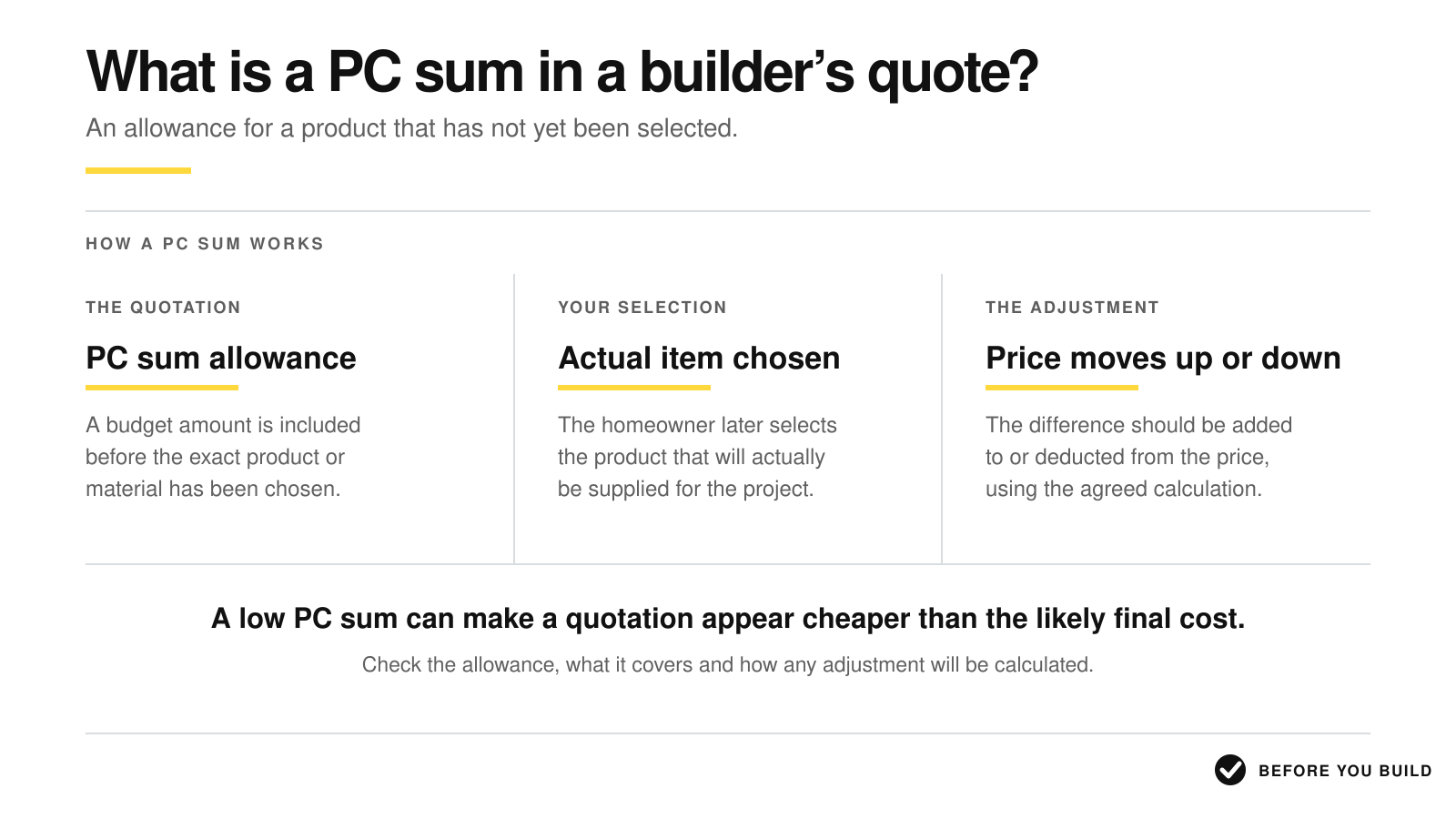
A PC sum—short for prime cost sum—is an allowance included in a builder’s quotation for a particular item, material or specialist element whose final selection or cost has not yet been confirmed.
It allows the builder to include a placeholder amount rather than leave the item entirely outside the quotation. Common examples might include sanitaryware, tiles, kitchen units, flooring or specialist subcontract work.
A PC sum should not automatically be treated as a fixed price. Once the actual item or supplier is selected, the quoted amount may need to be adjusted. Delivery, installation, waste, VAT and the builder’s overhead and profit may also sit outside the allowance, depending on the wording used.
For a homeowner, the important question is not simply whether a PC sum appears in the quotation. It is whether the allowance is realistic, what it covers and how any difference will be calculated.
The term is not always used consistently in domestic builders’ quotations, so the wording of the quotation and proposed contract must be checked carefully.
What Does PC Sum Mean in a Builder’s Quote?
A PC sum is normally a monetary allowance for something that has not been finally selected or priced when the builder prepares the quotation.
For example, a quotation might contain a £5,000 PC sum for kitchen units. If the units eventually cost £7,000, the project price may increase by the £2,000 difference, together with any applicable delivery, installation, waste, overhead, profit or VAT not already included.
If the selected units cost £4,000, the project price should normally be adjusted downwards where the quotation or contract provides for the PC sum to be reconciled against the actual cost.
The adjustment is only straightforward when the document explains:
- What the allowance covers
- Whether it is supply-only or includes installation
- Whether VAT is included
- Whether delivery and waste are included
- What builder’s margin will be added
- How the final cost will be evidenced
- Whether savings as well as increases will be passed back to you
Without this information, a PC sum can create the appearance of a complete price while leaving part of the homeowner’s final commitment uncertain.
PC Sum Worked Example
A builder’s quotation includes a £2,500 PC sum for the supply of floor tiles. The homeowner later selects tiles costing £3,400.
| Calculation | Amount |
|---|---|
| PC sum included in quotation | £2,500 |
| Actual cost of selected tiles | £3,400 |
| Difference above the allowance | £900 |
The basic price adjustment is £900. However, the final increase could be higher if delivery, wastage, the builder’s margin or VAT sits outside the original allowance.
The installation cost must also be checked separately. A £2,500 PC sum for the supply of tiles does not necessarily include the labour, adhesive, grout, trims, preparation or waste associated with fitting them.
The same principle applies in reverse. If the selected tiles cost less than the allowance, establish whether the saving will reduce the contract price and how that adjustment will be shown.
What Can a PC Sum Cover?
The exact meaning depends on the wording of the quotation or contract. A PC sum might be used for:
- Kitchen units or appliances
- Sanitaryware and bathroom fittings
- Wall and floor tiles
- Timber or resilient flooring
- Internal doors and ironmongery
- Light fittings
- Specialist glazing
- Joinery
- Landscaping materials
- A specialist supplier or subcontract package
In some documents, the PC sum may cover only the purchase price of an item. In others, it may include a wider supply package or an amount for work to be provided by a particular supplier or subcontractor.
Never assume that the heading “PC sum” tells you everything included. Ask the builder to define the allowance in writing.
What Might Be Excluded From a PC Sum?
Depending on the quotation, the allowance may exclude:
- Delivery charges
- Installation labour
- Fixings and ancillary materials
- Preparation and making good
- Wastage
- Storage and handling
- Plant or access equipment
- Subcontractor attendance
- Builder’s overhead and profit
- VAT
These costs can be substantial.
For example, a sanitaryware allowance may cover the basin, WC and taps but not the plumbing labour, frames, wastes, valves, sealants or boxing required to install them. A tile allowance may cover only the tiles and not the preparation, adhesive, grout, trims or fitting.
The quotation should therefore explain both the item allowance and the associated work.
PC Sum Versus Provisional Sum
PC sums and provisional sums both introduce an element of uncertainty, but they are not necessarily the same.
| PC sum | Provisional sum |
|---|---|
| Usually relates to a particular item, supplier or defined element | Usually relates to work that cannot yet be described or priced sufficiently |
| The general requirement may be understood, but the final selection or cost is unresolved | The scope, quantity, design or method may still be uncertain |
| Commonly associated with products, materials or specialist supply | Commonly associated with uncertain work such as drainage, foundations or repairs |
| Usually adjusted when the actual item or supplier cost becomes known | Adjusted when the work is properly defined and valued |
For example:
- A £3,000 allowance for sanitaryware could be described as a PC sum because the products have not yet been selected.
- A £5,000 allowance for possible drainage alterations could be a provisional sum because the required work cannot yet be established.
Domestic builders do not always use these terms consistently. The label matters less than obtaining a clear written explanation of what the allowance covers, what remains uncertain and how the eventual cost will be calculated.
Read our guide to provisional sums for a more detailed explanation of this distinction.
Why PC Sums Can Create Budget Risk
A PC sum is not automatically a problem. It becomes risky when the allowance is unrealistic or poorly defined.
Common risks include:
The allowance is too low
A low PC sum can make the overall quotation appear more competitive. If the allowance does not reflect the products or standard you expect, the price will increase once selections are made.
The quantity is unclear
An allowance of £40 per square metre for tiles is not enough information if the quotation does not also state the area, expected wastage and whether delivery is included.
Installation is omitted
Homeowners may assume a product allowance includes fitting when the quotation includes only supply.
The builder’s margin is unclear
The quotation may allow the builder to add overhead and profit to the actual cost, the difference above the allowance or the entire replacement amount. The calculation method should be agreed before appointment.
Savings are not addressed
Some documents explain how increases will be charged but say nothing about what happens when the actual cost is lower than the allowance.
There are numerous PC sums
Several individually modest allowances can create a large combined exposure. The quotation total may be materially lower than the eventual project cost if most of the allowances prove insufficient.
How to Check Whether a PC Sum Is Realistic
Use the following process before accepting the builder’s quotation.
1. Identify every allowance
Create a list of every PC sum, provisional sum and other estimated allowance in the quotation.
Do not rely only on items labelled “PC sum”. Also look for wording such as:
- Allow only
- Budget figure
- Estimate
- To be confirmed
- Client choice
- Subject to selection
- By specialist
- To be agreed
2. Confirm what each allowance covers
Ask whether the figure includes:
- Supply
- Delivery
- Installation
- Wastage
- Ancillary materials
- Builder’s margin
- VAT
3. Check the assumed quantity
A rate is only meaningful when the quantity is known. Confirm the number, area, length or specification assumed.
4. Compare the allowance with your expectations
If you already have a preferred kitchen, bathroom, floor or product standard, obtain an indicative supplier price before accepting the quotation.
5. Clarify the adjustment mechanism
Ask how the contract price will change when the actual cost becomes known.
The calculation should be understandable and capable of working both upwards and downwards.
6. Ask for evidence of the actual cost
Establish whether supplier quotations, invoices or other cost evidence will be provided when the allowance is adjusted.
7. Resolve important selections before signing
Where practical, select major products and obtain firm supplier prices before appointing the builder. Replacing allowances with defined products and fixed figures can improve cost certainty.
Questions to Ask About a PC Sum
Ask the builder to answer these questions in writing:
- What exactly does this PC sum cover?
- Is it supply-only or does it include installation?
- What quantity and specification have been assumed?
- Does the allowance include delivery and wastage?
- Is VAT included?
- Will overhead and profit be added?
- If so, what percentage applies and to which amount?
- How will the actual cost be evidenced?
- What happens if the final cost is below the allowance?
- What happens if the final cost exceeds it?
- Can the item be selected and priced before the contract is signed?
- Will the revised amount be agreed in writing before an order is placed?
These questions should be resolved before work starts, particularly where the allowance relates to a high-value item or a significant part of the project.
When Is a PC Sum Reasonable?
A PC sum can be reasonable when:
- A final product has not yet been selected
- The required item is understood
- The allowance reflects the expected quality
- The assumed quantity is stated
- The included and excluded costs are clear
- The adjustment procedure is transparent
- Both increases and savings will be recorded fairly
It may be sensible to retain an allowance where making every selection before appointment would cause unnecessary delay.
The objective is not necessarily to remove every PC sum. It is to ensure each allowance gives you a realistic basis for budgeting.
Warning Signs in a Builder’s Quote
Investigate further if:
- The allowance is substantially below the products you expect
- No specification or quantity supports the figure
- Installation responsibility is unclear
- VAT treatment is not stated
- The builder’s margin is unspecified
- Only increases—not savings—are addressed
- Supplier evidence will not be provided
- Major parts of the project are covered by allowances
- The builder will not explain how the figure was calculated
- Verbal explanations are not incorporated into the written quotation
A quotation containing several unclear PC sums cannot provide the same cost certainty as one based on defined selections and properly priced work.
How Multiple PC Sums Can Change the Final Price
Consider a quotation containing:
| Item | PC sum | Actual cost | Difference |
|---|---|---|---|
| Kitchen units | £10,000 | £14,000 | £4,000 |
| Sanitaryware | £4,000 | £6,500 | £2,500 |
| Flooring | £3,000 | £5,000 | £2,000 |
| Total | £17,000 | £25,500 | £8,500 |
The basic increase is £8,500 before considering any additional delivery, installation, margin or VAT that falls outside the allowances.
This is why PC sums should be reviewed collectively. Each figure may appear manageable, while the combined difference creates a substantial budget increase.
Frequently Asked Questions
Is a PC sum a fixed price?
Usually not. It is normally an allowance that will be replaced or adjusted when the actual cost becomes known. Check the wording of the quotation and contract.
Does a PC sum include labour?
Not necessarily. Some PC sums are supply-only, while others may cover a wider package. Ask the builder to define the scope.
Can a builder add profit to a PC sum?
The quotation or contract may allow overhead and profit to be added. The percentage and calculation method should be stated clearly before appointment.
What happens if the item costs less than the PC sum?
Where the allowance is reconciled against the actual cost, the contract price should normally reduce. Confirm the adjustment mechanism in writing.
Is a PC sum the same as a provisional sum?
No, although the terms are sometimes used inconsistently. A PC sum usually relates to a particular item or supplier cost. A provisional sum usually relates to work that is not yet sufficiently defined.
Should I reject a quotation containing PC sums?
Not automatically. PC sums can be legitimate where selections remain outstanding. The concern is whether the figures are realistic, clearly defined and subject to a fair adjustment process.
Can I replace a PC sum with a fixed price?
Often, yes. If the product, supplier, quantity and associated work can be confirmed before the contract is signed, ask the builder to replace the allowance with a firm figure.
Before You Accept the Builder’s Quote
A PC sum is not simply an administrative note. It is part of the project cost that remains open to adjustment.
Before accepting the quotation, make sure you understand:
- What the allowance covers
- What remains excluded
- Whether the amount is realistic
- Which additional charges could apply
- How the actual cost will be verified
- How increases and savings will affect the final price
The clearer these points are before appointment, the less room there is for unexpected costs and disagreement later.
Need Help Checking Your Builder’s Quote?
Before You Build provides independent builder quotation reviews for homeowners before a contractor is appointed.
We examine scope, allowances, provisional sums, exclusions, clarity and potential cost risks so you can resolve important questions before accepting a quotation or paying a deposit.
View our builder quote review services and pricing.
Before You Build provides independent practical observations based on the documents supplied. Builder quote reviews do not constitute structural engineering, legal or surveying advice, contract administration or project management.