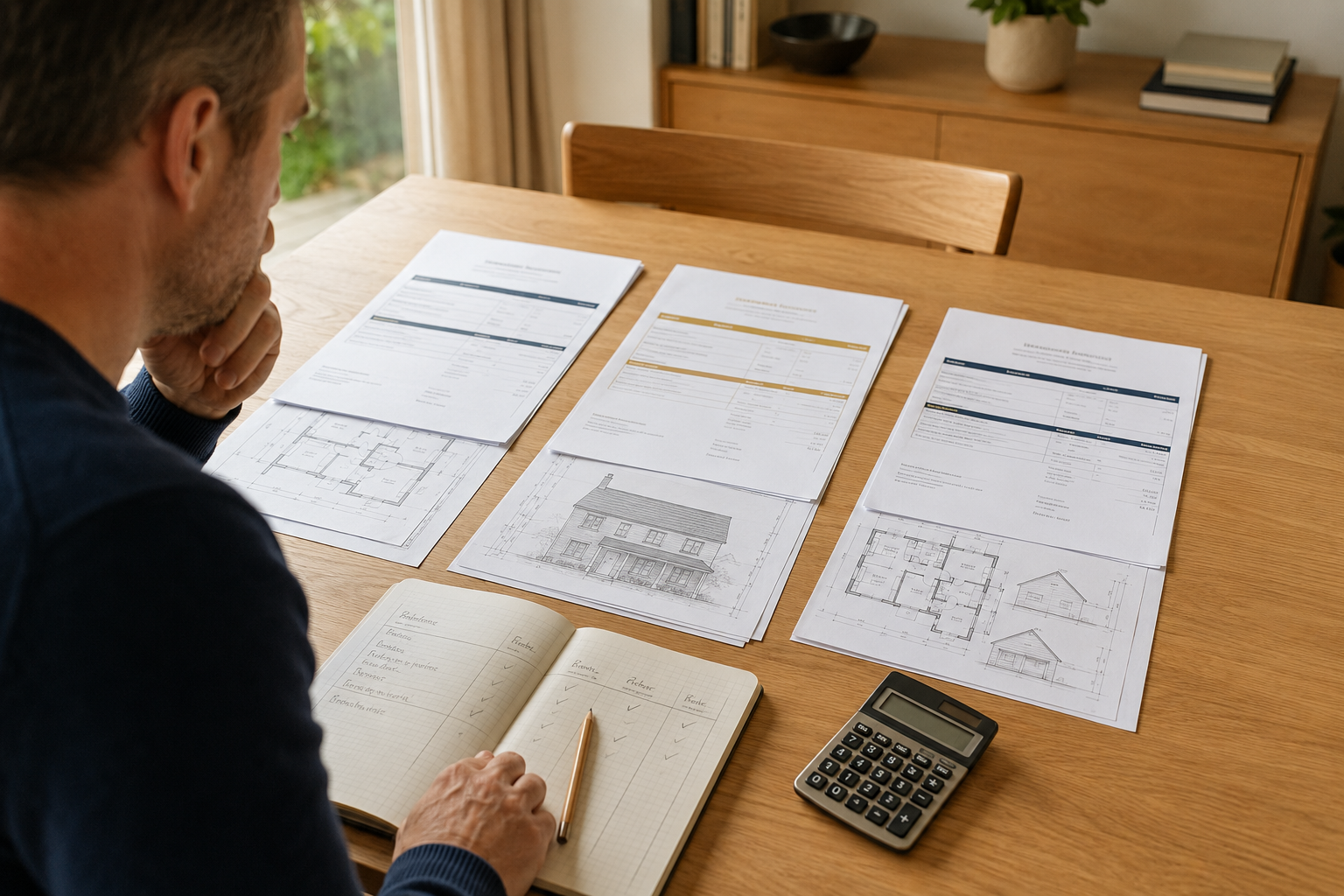
To compare builders’ quotes properly, first check that every builder has priced the same drawings, specifications and scope of work. Then compare each quotation line by line, separating fixed prices from provisional sums, identifying exclusions and client-supplied items, putting VAT on the same basis and allowing for essential work that is missing from the headline price.
Only after those differences have been resolved should you compare the likely total cost, payment terms, programme and suitability of each builder.
In brief: The lowest quotation is not necessarily the lowest-cost project. A fair comparison asks what each builder will provide, what remains uncertain, what you may need to pay for separately and how dependable the quoted total really is.
Before You Build provides independent, human-led comparisons of up to three builders’ quotations for UK homeowners, identifying differences in scope, specifications, exclusions, allowances, assumptions and potential cost risks before a contractor is appointed.
If you are still establishing whether the project is affordable, start with our guides to house extension costs and house renovation costs, which explain the difference between the builder’s quotation and the total project budget.
Why builders’ quotes cannot always be compared by price
Two builders can receive the same architectural drawings and still return very different quotations. Drawings show the intended building, but they do not always define every material, finish, responsibility, construction method or site assumption needed to calculate the price.
One builder may include scaffolding, decoration, utility alterations and final certification. Another may exclude those items or assume that you will arrange them separately. One may use realistic allowances for groundworks and sanitaryware; another may use much lower figures that reduce the initial quotation but leave more cost unresolved.
The result is that the headline totals may represent different packages of work.
If your prices are far apart, our guide to why builders’ quotes can be so different explains the main causes. The comparison process below shows how to identify and account for them.
What does “like-for-like” comparison mean?
A like-for-like comparison means putting every quotation onto the same basis before judging which offers the best value.
That requires you to compare:
- the same design documents and drawing revisions;
- the same work and responsibilities;
- equivalent materials and standards of finish;
- equivalent provisional sums and product allowances;
- the same VAT basis;
- essential excluded work that will still need to be paid for;
- programme, payment and contract terms; and
- the uncertainty that remains within each price.
It does not mean forcing every builder to price the project in exactly the same way. Builders may use different teams, suppliers, construction methods and management arrangements. Those differences can be legitimate. The purpose is to make them visible so you can decide whether they represent better value, greater certainty or additional risk.
Before comparing quotations: check the information issued
The quality of the comparison begins before the quotations arrive.
Each builder should, as far as possible, receive the same tender information at the same time. Depending on the project, that may include:
- architectural drawings and revision numbers;
- structural drawings and calculations;
- a schedule of works or written specification;
- planning and Building Regulations information;
- window, door, kitchen, bathroom and finish schedules;
- electrical, plumbing, heating and ventilation requirements;
- site surveys, drainage information or asbestos reports;
- details of access, occupation and working restrictions; and
- the same tender questions and return date.
If one builder priced an earlier drawing or received extra information during a site visit, the quotations may not share the same basis. Ask each builder to list the documents and revisions used.
Where the information is incomplete, do not assume the builders have filled the gaps in the same way. Their assumptions need to be written down and compared.
How to compare builders’ quotes step by step
1. Confirm whether each document is a quote or an estimate
Start by reading how each document describes itself.
A quotation is normally presented as an agreed price for a defined scope, subject to its stated terms, exclusions, allowances and any later agreed changes. An estimate is an approximate prediction of cost and provides less price certainty.
Citizens Advice recommends obtaining a written quote rather than relying on an estimate and recording the price and work details in writing.
For each submission, record:
- whether it says quotation, estimate, budget or cost plan;
- how long the price remains valid;
- whether inflation or material price increases can be added;
- what could change the price;
- how provisional sums will be adjusted; and
- whether the builder’s terms are included.
Do not compare a detailed fixed quotation with a preliminary estimate as if they provide the same certainty.
2. Confirm the drawings, specifications and revisions priced
Create a document list and ask every builder to confirm it.
For example:
| Tender information | Builder A | Builder B | Builder C |
|---|---|---|---|
| Architectural drawing revision C | Confirmed | Earlier revision B | Confirmed |
| Structural engineer’s drawings | Confirmed | Unclear | Confirmed |
| Electrical layout | Confirmed | Not issued | Confirmed |
| Kitchen supplied by client | Confirmed | Included by builder | Confirmed |
A single revision difference can affect openings, steelwork, glazing, finishes or room layouts. Resolve it before interpreting the price gap.
If a builder needs to revise the quotation after receiving missing information, ask for the updated position in writing.
3. Break the work into comparable sections
Do not rely on the builder’s headings alone. Build one master list of work packages and compare every quotation against it.
For an extension or major renovation, the sections might include:
- preliminaries, supervision and site setup;
- protection of the existing property;
- demolition and temporary works;
- excavation, foundations and groundworks;
- drainage and below-ground services;
- masonry, structure and steelwork;
- roofing, rainwater goods and rooflights;
- windows and external doors;
- insulation, airtightness and fire protection;
- internal partitions, plastering and carpentry;
- plumbing, heating and ventilation;
- electrical work, lighting and certification;
- kitchens, bathrooms and fitted items;
- flooring, tiling and decoration;
- external works, landscaping and making good;
- scaffolding, plant, skips and waste removal;
- testing, commissioning and completion documents; and
- Building Control, professional or statutory fees.
Mark each section as:
- Included — clearly priced within the quotation;
- Excluded — expressly outside the builder’s price;
- Provisional — included as an allowance rather than a fixed price;
- By client or others — your responsibility to arrange or purchase; or
- Unclear — not sufficiently described to confirm the position.
Silence is not evidence that an item is included. If the quotation does not mention something important, mark it as unclear and ask the builder.
For a fuller scope checklist, read What Should a Builder’s Quote Include?.
4. Compare the specification, not only the work description
Two quotations may both include “windows”, “bathroom”, “electrics” or “flooring” while allowing for very different products and quantities.
Check whether each quote identifies:
- product, manufacturer or performance standard;
- material type, size, finish and colour;
- quantity or measured area;
- installation method and associated preparation;
- delivery, access, lifting and storage;
- waste, sundries and making good;
- testing, commissioning and certification; and
- what happens if your final selection costs more or less.
For example, “electrical installation included” does not tell you the number of sockets, lighting points, external supplies, data points, smoke alarms or whether the consumer unit requires replacement.
Where selections have not been made, ask every builder to use the same realistic specification or allowance. Otherwise, a quotation can appear cheaper simply because it prices a lower standard.
5. List every exclusion and client responsibility
Exclusions are not savings if the excluded work is still necessary to complete the project.
Create a separate list covering:
- work excluded by the builder;
- products you are expected to purchase;
- work to be completed by other contractors;
- design, survey and approval costs;
- temporary arrangements and protection;
- final connections, testing or certification;
- decorating, flooring, cleaning and making good; and
- any VAT or delivery that sits outside the stated amount.
Then decide whether each item is:
- genuinely unnecessary;
- already covered elsewhere;
- a client choice that should remain separate; or
- essential project work that must be added to the comparison.
Client-supplied materials also create responsibilities. Confirm who measures, orders, checks, unloads, stores, installs and deals with delays or defects. A builder excluding the supply of a kitchen does not necessarily mean all kitchen-related labour, alterations and coordination are included.
6. Separate fixed prices from provisional sums and allowances
A quotation total can contain substantial amounts that are not fixed.
A provisional sum is generally an allowance for work that cannot yet be fully defined or accurately priced. Groundworks, drainage alterations and repairs to an existing structure are common examples.
A PC sum, sometimes described as a prime cost or product allowance, is commonly associated with an item that has not yet been selected, such as sanitaryware, tiles or ironmongery. The precise meaning and adjustment mechanism depend on the wording of the quotation or contract.
For every allowance, record:
- the amount;
- exactly what it covers;
- the assumed quantity and quality;
- whether it includes labour and installation;
- whether it includes delivery, waste and VAT;
- whether overhead and profit will be added;
- how the final cost will be evidenced and adjusted; and
- any programme effect if the decision is delayed.
Compare equivalent allowances. If Builder A allows £2,000 for sanitaryware and Builder B allows £8,000, the £6,000 difference does not necessarily mean Builder A is more competitive. It may mean the quotations assume different products or defer different amounts of cost.
BYB expert tip: Compare the fixed-price content separately from the uncertain content. The quotation with the lowest total may still transfer the greatest amount of cost risk to you.
7. Put VAT on the same basis
Record whether each figure includes VAT, excludes VAT or uses a particular VAT rate.
GOV.UK guidance for builders states that most work on houses and flats is charged at the standard rate of 20%, although exceptions can apply. Do not assume an unusual VAT treatment is correct without checking the current rules or obtaining appropriate advice.
For comparison purposes, create a total showing the amount you expect to pay including VAT. Do not compare one VAT-exclusive quotation with another VAT-inclusive quotation.
For example:
- £90,000 including VAT = £90,000 payable;
- £80,000 plus VAT at 20% = £96,000 payable.
The second quotation is not £10,000 cheaper once both are put onto the same basis.
8. Calculate an adjusted comparison total
Once scope, specification, exclusions, allowances and VAT have been reviewed, calculate an adjusted figure for comparison.
Use:
VAT-inclusive quotation
+ essential excluded work
+ adjustment for unrealistic or unequal allowances
= adjusted comparison total
This is not a replacement quotation and it does not guarantee the final project cost. It is a decision-making tool that shows what the prices may look like when placed on a more consistent basis.
Do not silently invent figures for missing work. Obtain a price where possible. If a reliable figure is unavailable, record the item as an unresolved risk rather than pretending the comparison is exact.
9. Compare the programme and delivery arrangements
Price is only one part of the offer.
Compare:
- proposed start date;
- estimated duration;
- number of people expected on site;
- who will supervise the works;
- which packages will be subcontracted;
- whether the property will remain occupied;
- working hours and access arrangements;
- long-lead products and decision deadlines;
- responsibility for sequencing client suppliers; and
- how delays or extensions of time will be dealt with.
A higher quotation may include more supervision, a larger team or a shorter programme. A lower quotation may rely on a smaller team or a start date that does not meet your needs. Neither position is automatically wrong, but it should form part of the comparison.
10. Compare payment and contract terms
The timing and basis of payment can materially change the risk of appointing a builder.
Check:
- the deposit requested and what it secures;
- whether payments are linked to defined stages or valuations;
- the value of each payment compared with work completed;
- whether materials are paid for before delivery;
- the process for pricing and approving variations;
- whether any retention is proposed;
- the final payment and practical-completion requirements;
- defects and return arrangements;
- insurance requirements;
- dispute provisions; and
- the proposed written building contract.
Avoid comparing only the payment percentages. A stage called “plastering complete” needs a clear definition if other work, testing or making good remains outstanding.
A quotation is not a complete substitute for a suitable written contract. JCT provides Home Owner Contracts designed for homeowners appointing consultants or contractors. The appropriate form depends on the project and professional advice may be needed for larger or more complex work.
11. Assess the builder as well as the quotation
Normalising the prices tells you more about the financial offer. It does not decide whether the builder is suitable.
Also assess:
- relevant experience on comparable projects;
- references and recent completed work;
- insurance and business details;
- who will actually manage and carry out the work;
- communication and willingness to clarify the quotation;
- availability and realistic workload;
- approach to quality control and defects;
- health and safety arrangements; and
- whether the proposed contract and payment demands are reasonable.
For domestic projects, the Health and Safety Executive’s CDM guidance explains how domestic-client duties normally pass to the contractor, principal contractor or another dutyholder. Establish who will perform the relevant roles rather than assuming the quotation has dealt with them.
The clearest quotation does not prove that a builder will perform well, and the highest price does not prove quality. References, competence, resources and the proposed working relationship still matter.
12. Resolve differences in writing before choosing
Create one clarification schedule and send the relevant questions to each builder.
Where an answer changes the scope, specification or price, ask for:
- a revised quotation; or
- a clearly numbered written clarification incorporated into the contract documents.
Avoid relying on separate phone calls and informal assurances. Important answers can be forgotten or interpreted differently once work begins.
If one builder identifies a missing design issue that affects every tenderer, issue the same information to the others so the comparison remains fair.
Worked example: the cheapest quote changes after comparison
The following figures are illustrative.
| Comparison | Builder A | Builder B | Builder C |
| Submitted quotation | £88,000 + VAT | £115,000 incl. VAT | £121,000 incl. VAT |
| VAT-inclusive quotation | £105,600 | £115,000 | £121,000 |
| Essential excluded work | £10,000 | £2,000 | £0 |
| Allowance adjustment | £6,000 | £3,000 | £0 |
| Adjusted comparison total | £121,600 | £120,000 | £121,000 |
| Remaining uncertainty | High | Moderate | Lower |
Builder A initially appears £33,000 cheaper than Builder C if the submitted figures are read without adjusting for VAT. Once VAT, essential exclusions and inadequate allowances are placed on a consistent basis, Builder A becomes the highest adjusted total and still contains the most uncertainty.
This does not mean Builder A is unsuitable or Builder C is automatically best. It means the original headline figures did not describe equivalent offers. The next decision should consider clarification, specification, programme, contract terms and the suitability of each builder.
A simple builders’ quote comparison table
You can use the following structure to create your own comparison:
| Item | Builder A | Builder B | Builder C | Action required |
| Price basis | Quote | Estimate | Quote | Request fixed quote from B |
| VAT | Excluded | Included | Unclear | Confirm C and calculate totals |
| Drawing revisions | Current | Current | Earlier issue | Ask C to revise |
| Groundworks | Provisional | Fixed with exclusions | Provisional | Compare scope and assumptions |
| Electrical work | Vague | Point schedule included | First fix only | Obtain full breakdown |
| Decoration | Excluded | Included | Included | Add realistic cost to A |
| Sanitaryware | £2,000 allowance | £6,000 allowance | Client supply | Put onto equivalent basis |
| Programme | 20 weeks | 24 weeks | Not stated | Confirm C |
| Payment terms | Large advance stages | Monthly valuation | Stage payments | Assess payment exposure |
The “action required” column is important. A comparison sheet should not merely record differences; it should tell you what must be resolved before appointment.
Questions to ask builders when comparing quotes
Ask the questions that are relevant to your project and keep the answers in writing:
- Is this a fixed quotation or an estimate?
- Which drawings, specifications and revision numbers have you priced?
- Please confirm every exclusion and all work expected from the client or others.
- Which elements are provisional, estimated or subject to remeasurement?
- What does each allowance include, and how will it be adjusted?
- Are delivery, installation, waste, overhead, profit and VAT included in the allowances?
- What assumptions have been made about foundations, drainage and the existing structure?
- Are scaffolding, welfare, protection, skips, cleaning and making good included?
- What electrical, plumbing, heating, ventilation and certification work is included?
- Are decoration, flooring, external works and completion items included?
- Who will supervise the project and which work will be subcontracted?
- What start date, duration and staffing have been assumed?
- How long is the price valid?
- What payment schedule is proposed?
- How will variations be described, priced and approved before the work proceeds?
- What form of written contract is proposed?
An answer such as “everything is included” is not sufficiently precise for a substantial project. Ask for the relevant scope and responsibility to be identified.
Warning signs when comparing builders’ quotations
Some of the most important risks sit in short descriptions and apparent gaps rather than the headline total. Our guide to things homeowners often miss in renovation quotes covers these common problem areas in more detail.
Investigate rather than ignore:
- a price significantly below the others with no clear explanation;
- a quotation based on outdated or unidentified drawings;
- important work that is absent rather than expressly excluded;
- extensive use of vague wording such as “as necessary” or “standard finish”;
- large or unrealistic provisional sums;
- allowances that omit installation or associated work;
- no clear VAT position;
- a large deposit or payment schedule running ahead of progress;
- no proposed written contract;
- reluctance to explain material differences;
- an unrealistically short programme;
- missing insurance or business information; or
- pressure to accept before questions have been answered.
One warning sign does not prove dishonesty or incompetence. It identifies something that requires clarification before you rely on the price.
Should you choose the cheapest builder’s quote?
Not automatically—but a cheap quotation is not automatically wrong either.
After normalisation, the lowest quotation may remain credible because the builder has lower overheads, favourable supplier rates, an efficient method or a project that fits the team’s programme. Equally, it may remain low because scope is missing, allowances are unrealistic or uncertainty has been transferred to you.
The objective is to identify which explanation applies.
Our guide Should I Choose the Cheapest Builder’s Quote? explains how to assess a low price without assuming that cheap always means poor or that expensive always means better.
What if you only have one builder’s quote?
You can still assess whether the quotation provides a dependable basis for appointment.
Check the scope, specifications, exclusions, allowances, VAT, programme, payment terms and contract position using the same method. Compare the quotation with the design information and your known project requirements rather than comparing it only with another price.
Our guide Is My Builder’s Quote Reasonable? explains how to assess a single quotation without relying solely on online cost averages.
When should you obtain professional help?
Consider further help where:
- the quotations are too different to reconcile;
- the project is high value or technically complex;
- the scope or design information is incomplete;
- substantial provisional sums remain;
- structural, heritage or hidden-condition risks are significant;
- you cannot establish a dependable likely total;
- contract or payment terms are unclear; or
- the builders’ answers create further uncertainty.
The right support depends on the issue. An architect, quantity surveyor, structural engineer, project manager, contract administrator or legal adviser may be required for design, cost planning, engineering, procurement, contract or dispute matters.
Before You Build complements those professionals by providing independent, practical scrutiny of builders’ quotations from the homeowner’s side before a contractor is appointed.
Frequently asked questions
How do I compare builders’ quotes like for like?
Confirm that each builder priced the same documents and scope. Compare inclusions, exclusions, specifications and allowances line by line, put VAT on the same basis and add the cost of essential excluded work. Then compare the adjusted totals, remaining uncertainty, programme, payment terms and builder suitability.
What should I compare besides the total price?
Compare scope, material specification, provisional sums, product allowances, exclusions, client responsibilities, VAT, programme, supervision, payment schedule, variation procedure, insurance and contract terms. These factors determine what the price actually buys and how much risk remains.
How many builders’ quotes should I compare?
For many domestic projects, three written quotations provide a useful comparison. However, the quality and consistency of the tender information matter more than collecting numerous prices that cannot be compared reliably.
What if the builders use completely different formats?
Create your own master comparison sheet organised by work package. Transfer each builder’s information into the same rows and mark items as included, excluded, provisional, client-supplied or unclear. Send written questions where the documents do not provide an answer.
Can AI compare builders’ quotes?
AI tools can help extract and organise information from builders’ quotations, but their answer is only as reliable as the documents and context provided. They may not recognise omitted work, unrealistic allowances, site-specific assumptions or conflicts between the quotation and the design information. Before uploading confidential quotations, check how the tool stores and uses your documents. Before You Build’s reviews are completed by an experienced renovation contractor, providing independent, human-led scrutiny before a builder is appointed.
Should I ask builders to provide a detailed breakdown?
Yes, the detail should be proportionate to the size and complexity of the project. You need enough information to understand the scope, specifications, allowances, exclusions and payment stages. A builder may not disclose every internal labour or material rate, but should be able to explain what the quotation provides.
Can I add exclusions to a quote when comparing prices?
Yes, where excluded work is essential to complete the project, include a realistic figure or obtain a separate price so it is not treated as a saving. Keep client choices and professional fees separate where appropriate, but apply the same treatment to every quotation.
Is an adjusted comparison total the expected final cost?
No. It is a comparison tool, not a new quotation or cost guarantee. It helps put different offers onto a common basis. Unknown conditions, later design changes, selections and agreed variations may still affect the final cost.
Should I negotiate the price before comparing the scope?
Resolve the scope and quotation differences first. Asking a builder to reduce a correctly calculated price without changing the work may simply create pressure elsewhere. Once the offers are comparable, you can discuss genuine alternatives, specification changes or scope reductions openly.
Before you appoint a builder
Do not choose until you can answer four questions clearly:
- What exactly will each builder provide?
- What will you need to arrange or pay for separately?
- Which parts of the price can still change?
- What is each project realistically likely to cost on a comparable basis?
The best-value quotation is not necessarily the lowest or the most detailed. It is the one that offers an appropriate balance of scope, quality, cost, certainty and dependable delivery for your project.
Need help comparing builders’ quotes?
Before You Build provides independent builder quotation reviews for UK homeowners before a contractor is appointed. Every review is carried out personally by an experienced renovation contractor rather than an automated tool.
Our Full Comparison examines up to three quotations side by side, identifying differences in scope, specifications, exclusions, allowances, assumptions and potential cost risks. The aim is not to choose a builder for you, but to give you a clearer and more consistent basis for making your decision.
View BYB builder quote review services and pricing
Before You Build provides independent practical observations based on the documents supplied. Reviews do not constitute structural engineering, quantity surveying, legal or surveying advice, contract administration or project management.