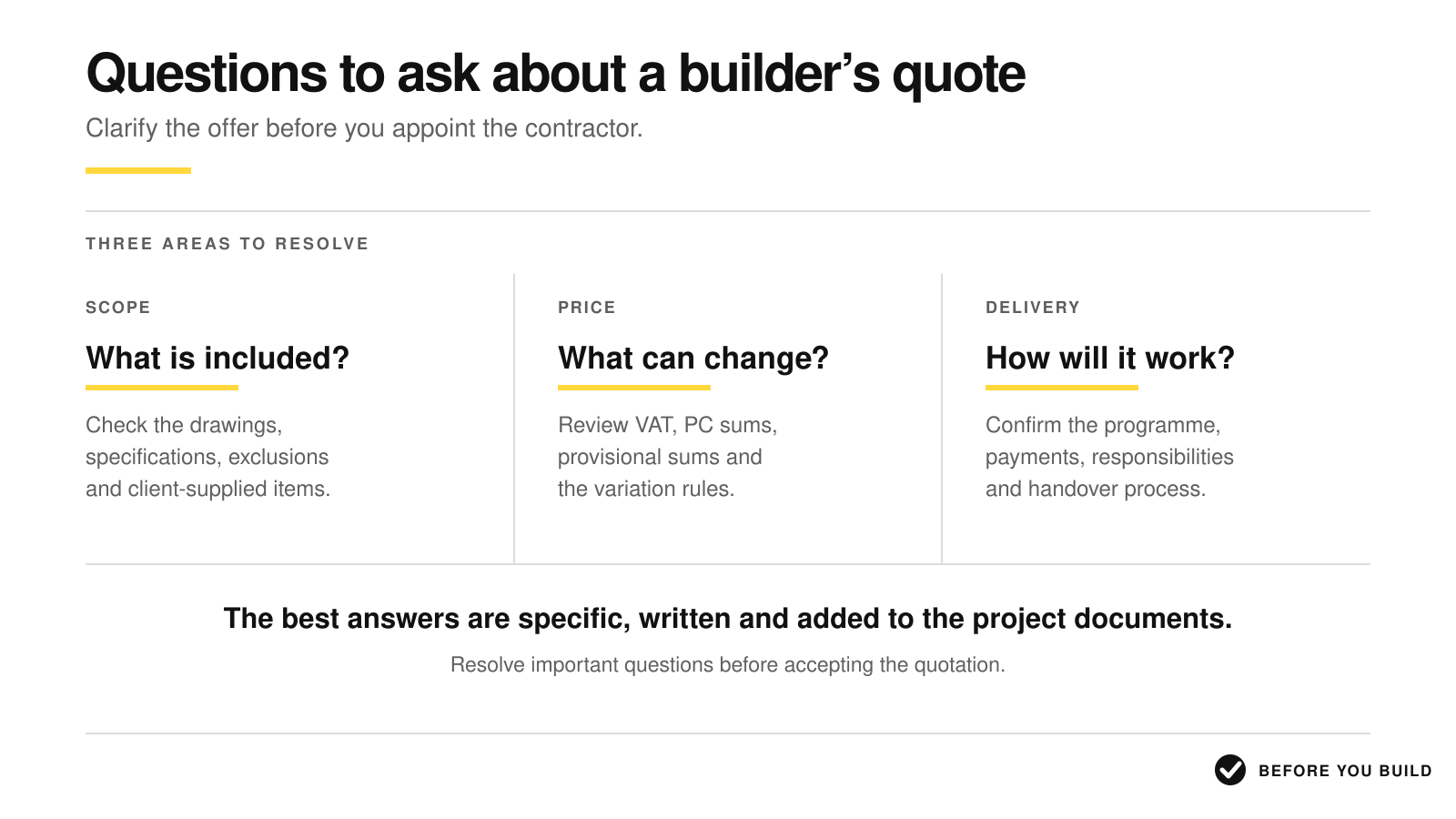
Before accepting a builder’s quote, ask questions that establish exactly what has been priced, what has been excluded, which figures can change, whether VAT is included, how payments and variations will work, and who is responsible for each part of the project.
A total price on its own is not enough. The most useful answers are specific, written and incorporated into a revised quotation, specification, schedule of works or contract. That creates a clearer basis for comparing builders and reduces the risk of discovering important gaps after work has started.
This guide gives you 30 practical questions to ask a builder about their quote before you appoint them.
The Most Important Questions at a Glance
If you only have time for an initial review, start with these questions:
- Which drawings, specifications and revisions did you use to prepare this quotation?
- Is everything needed to complete the stated project included?
- What is specifically excluded?
- Which items are allowances rather than fixed prices?
- Are the PC sums and provisional sums realistic for the standard I expect?
- Does the total include VAT, and at what rate?
- What could legitimately change the quoted price?
- How will variations be priced and approved?
- What is the payment schedule, and what completed work does each payment relate to?
- Will you issue a revised written quotation incorporating all agreed clarifications?
These questions are not about catching a builder out. A detailed quotation takes time to prepare, and genuine unknowns can remain on renovation and extension projects. The aim is to distinguish clearly priced work from assumptions, exclusions and unresolved risk.
Questions About the Information Used to Price the Work
A quotation can only be as reliable as the information on which it is based. If different builders priced different drawings or made different assumptions, their totals may not be comparable.
1. Which drawings and documents did you use?
Ask the builder to list the documents used, including drawing numbers, revision letters or dates, structural information, specifications, schedules and any written brief.
This matters because a quotation prepared from an early planning drawing may not include details shown on later construction drawings. If the design has changed since the builder priced the work, ask whether the quote needs to be updated.
2. Have you allowed for everything shown on those documents?
Do not assume that receiving a drawing means every item on it has been priced. Ask the builder to confirm whether the quotation includes all work shown, or to identify anything omitted.
If there is a conflict between the drawings, specification and quotation, ask which document takes priority. The answer should eventually be reflected in the contract documents.
3. What assumptions did you make where information was missing?
Common assumptions might relate to foundations, drainage routes, steelwork connections, electrical points, floor finishes, access, waste removal or the condition of the existing building.
An assumption is not automatically a problem. An unstated assumption is a risk because you cannot judge whether it matches what you expect.
4. Have you inspected the site and existing property?
Ask what the builder was able to inspect and whether any areas were inaccessible or concealed. For an extension or renovation, existing conditions can materially affect the work.
Also ask what investigation would reduce uncertainty before the contract is agreed. Examples may include opening-up work, drainage surveys, trial holes or further design information. The appropriate investigation depends on the project and should be discussed with the relevant professional.
Questions About Scope and Inclusions
The scope defines what the builder is agreeing to provide. Broad descriptions such as “complete extension” or “all building works” can sound comprehensive while leaving room for very different interpretations.
5. Can you provide an itemised breakdown of the work?
Ask for the price to be divided into logical sections, such as preliminaries, demolition, groundworks, structure, roof, windows and doors, plumbing, electrical work, plastering, finishes and external works.
An itemised quotation helps you understand what has been included, compare quotations more fairly and identify where clarification is needed. It does not need to disclose every element of the builder’s internal costing, but it should describe the work clearly enough for you to understand the offer.
6. Does the quote include all labour, materials, plant and subcontractors?
Ask whether the stated prices include the labour, materials, equipment and specialist trades needed to complete each item. Check whether scaffolding, skips, lifting equipment, temporary protection and delivery charges are included where relevant.
If something will be charged separately, ask for it to be identified now.
7. Are demolition, removal and disposal included?
Clarify who will disconnect, remove and legally dispose of existing kitchens, bathrooms, finishes, walls, soil, rubble and packaging.
A line for demolition does not always include waste disposal, and a skip allowance may not cover every load. Ask whether waste quantities or skip numbers are limited and what happens if more are required.
8. Are making good and final finishes included?
Ask what will happen to areas disturbed by the work. This can include plaster repairs, decorating, flooring, skirting, paving, landscaping and making good around new services.
“Making good” is open to interpretation. Ask the builder to describe the expected finish and the extent of the area included.
9. Who is responsible for temporary works and protection?
Depending on the project, temporary works may include propping, weatherproofing, temporary supports, security, dust control and protection to retained parts of the home.
Ask what has been allowed for and whether specialist temporary-works design is required. Your architect, structural engineer or other relevant professional may need to advise on design responsibilities.
10. Are testing, commissioning and handover included?
Clarify whether the builder will test and commission installed systems and provide the certificates, manuals, guarantees and warranties required at handover.
Ask who will arrange inspections and provide evidence for items such as electrical work, gas work, glazing, heating systems and Building Regulations compliance where applicable.
Questions About Specifications and Materials
A quote can name an item without defining its quality, model or performance. If the specification is vague, the builder and homeowner may be picturing different products at different prices.
11. Which products, brands and performance standards have you priced?
For important items, ask for a clear specification rather than a generic description. Depending on the work, this may include:
- window and door systems;
- insulation type and thickness;
- roof coverings;
- sanitaryware and brassware;
- boilers, heat pumps or heating controls;
- kitchen units and worktops;
- floor and wall finishes;
- sockets, switches and light fittings; and
- paint systems and number of coats.
Where an exact product has not been selected, ask for the budget, basis or minimum standard used.
12. Are quantities and installation accessories included?
The visible product is not always the full cost. Tiles may also require adhesive, grout, trims, tanking and preparation. Flooring may require underlay, thresholds and levelling. Sanitaryware may require frames, wastes, valves and fittings.
Ask whether the quotation includes the complete installed system, not just the main product.
13. What happens if a specified product is unavailable?
Ask how substitutions will be proposed, approved and priced. A substitute should not be accepted merely because it is available; it should be suitable for the design, performance and finish required.
Any change should be recorded in writing before it is ordered or installed.
Questions About Exclusions and Homeowner-Supplied Items
An exclusion is work or cost that the builder has not included. Exclusions are easier to manage when they are explicit; the greater risk is work that neither party realises has been omitted.
14. Please list every exclusion from the quotation
Ask for a single, clear exclusions section. Do not rely on omissions scattered across emails or on the assumption that an unmentioned item must be included.
Review the exclusions against the drawings, specification and your expected finished result. Decide who will provide each excluded item, when it is needed and how it will interface with the builder’s work.
15. Which items do you expect me to buy or arrange?
Homeowner-supplied items might include kitchens, appliances, tiles, sanitaryware, light fittings or specialist finishes. Ask whether the builder’s price includes unloading, storage, protection, installation, testing, waste disposal and responsibility for damage.
Also ask who checks quantities and compatibility before you order. A product supplied by the homeowner can still cause delay or extra cost if it arrives late, is incomplete or does not fit.
16. Are professional and statutory fees excluded?
Clarify whether the price excludes architect, structural engineer, party wall surveyor, building control, planning, warranty provider or utility-company charges.
These services may sit outside a builder’s normal scope. The important point is to identify them and assign responsibility rather than assume someone else has included them.
17. Are utility connections and upgrades included?
Ask about new or altered gas, electricity, water, drainage, broadband and other services. Establish whether the builder has included only the work within the property or also any charges and work by the relevant utility provider.
Questions About PC Sums, Provisional Sums and Other Allowances
Allowances are not the same as fully fixed prices. They can be reasonable where a product has not been selected or the scope cannot yet be defined, but you need to understand how they will be adjusted.
18. Which figures are PC sums?
A PC sum usually allows for the supply of an item that has not yet been finally selected, such as tiles or sanitaryware. Ask the builder to identify every PC sum and state:
- the amount allowed;
- whether it is per item, per square metre or a total allowance;
- whether it covers supply only;
- whether delivery, wastage, installation and related materials are included elsewhere; and
- how any difference will be calculated.
Then check whether each allowance is realistic for the quality and quantity you expect.
19. Which figures are provisional sums?
A provisional sum is generally used where the work cannot yet be described or priced with sufficient certainty. Ask what scope the provisional sum is intended to cover, why it remains uncertain and what information is needed to replace it with a firmer price.
Also ask how the final amount will be calculated and what supporting breakdown you will receive.
20. Do the allowances include overheads, profit and VAT?
The adjustment may involve more than the difference between an allowance and the eventual supplier invoice. Ask whether handling, attendance, wastage, delivery, overheads, profit and VAT will be added, and at what agreed rate or basis.
This should be clear before you compare the allowance with a retail product price.
21. Can any allowance be resolved before appointment?
Ask whether further selections, drawings, surveys or investigations would allow an uncertain sum to be converted into a defined price.
Not every allowance can be removed, particularly in an existing property. However, resolving the largest or least defined figures can make the likely outturn cost easier to understand.
Questions About the Price and VAT
22. Is this a quote or an estimate?
Ask the builder to state this expressly. A quote is intended to be an agreed price for defined work, subject to its stated terms and agreed changes. An estimate is an indication of likely cost and can change as the information develops.
The heading on the document is not enough if the wording underneath allows most of the price to vary. Read the qualifications, assumptions and adjustment clauses as well as the total.
23. Does the total include VAT?
Ask for the VAT position to be shown in writing, including the rate and amount where applicable. Most building work on existing houses and flats is charged at the standard VAT rate, although exceptions can apply to qualifying work.
Do not add or remove VAT yourself based on an assumption. Ask the builder to confirm the correct treatment for the work and obtain professional tax advice where necessary.
24. How long is the quotation valid?
Materials, subcontractor prices and availability can change. Ask for an expiry date and what happens if you accept after that date or delay the start.
If the builder includes a price-fluctuation clause, ask which costs it applies to, how increases will be evidenced and whether reductions are treated in the same way.
25. What circumstances can change the price?
Ask the builder to list the reasons the total may change. Typical categories may include homeowner changes, design revisions, instructed additional work, specified allowances, genuinely unforeseen conditions or delayed decisions.
Avoid a broad statement that “extras will be charged” without a process for describing, pricing and approving them.
Questions About Programme and Site Arrangements
26. When can you start, and how long will the work take?
Ask for an anticipated start date, project duration and key stages. Establish whether these are firm commitments, current expectations or dependent on planning, Building Regulations approval, material lead times or another project finishing.
For work that affects your living arrangements, ask how delays and extensions of time will be recorded and communicated.
27. Who will manage the work day to day?
Ask who your main contact will be, who will supervise the site and how often the named builder or project lead will attend. Clarify which trades are employees and which are subcontracted.
The purpose is not to reject subcontracting; it is to understand responsibility, communication and coordination.
28. What site arrangements are included?
Discuss access, parking, working hours, deliveries, storage, scaffolding, skips, security, dust and noise control, temporary water or electricity, use of household facilities, cleaning and protection of occupied areas.
Ask whether any of these arrangements depend on you obtaining permission or providing space, power or water.
Questions About Payments, Variations and the Contract
29. What is the payment schedule?
Ask for each payment to be linked to a clearly defined stage or completed work, rather than simply to dates. Clarify the deposit, interim payments, final payment and any retention, together with how work will be assessed before payment.
Ask what invoices and supporting information will be provided. For a larger project, your architect, quantity surveyor, contract administrator or other appointed professional may advise on valuations and payment arrangements.
30. How will variations be agreed?
Agree a written process before work starts. A useful variation record should describe the change, state the price or pricing basis, explain any effect on the programme and show approval before the work proceeds, except where urgent action is genuinely necessary.
Also ask:
- who is authorised to instruct a change;
- whether quotations for changes include overheads, profit and VAT;
- how omitted work will be credited;
- how daywork will be recorded; and
- what happens if price and time cannot be agreed immediately.
Finally, ask which written contract will be used and whether the agreed quotation, drawings, specification, clarifications and programme will be identified as contract documents.
Ask About the Builder as Well as the Quote
A detailed quote is important, but it is not a complete contractor check. Before appointment, also confirm:
- the legal name and address of the business you will contract with;
- appropriate insurance and current certificates;
- relevant experience on comparable projects;
- recent references that you can verify;
- responsibility for health and safety;
- required trade registrations and certifications;
- guarantees or warranties and who provides them;
- the snagging and defects process; and
- how disputes will be handled.
These checks sit alongside the quotation review. A well-presented price does not by itself establish competence, capacity or financial stability.
Put the Answers in Writing
A productive quotation discussion often reveals genuine omissions or points that simply need defining. The next step is not to rely on your memory of the conversation. Ask the builder to update the documents.
For example, this answer is still unclear:
“Yes, the bathroom is included.”
A more useful written clarification would identify what “included” means:
“The price includes plumbing and installation of one WC, one basin, one shower tray and enclosure supplied by the client. The client’s sanitaryware purchase cost, wall tiles, floor tiles, decorating and accessories are excluded. Tile adhesive, grout, trims and labour to install up to 24 square metres of tiles are included.”
The second version lets you see the boundary between the builder’s work and the homeowner’s purchases. It can also be checked against other quotations.
If an answer changes the scope or price, request a revised quotation. If it defines how the project will be delivered, ensure it is included in the specification, schedule or contract as appropriate.
How to Compare the Answers From Different Builders
Ask each shortlisted builder the same core questions and record the answers in the same order. Then compare:
- Scope: Are they pricing the same work?
- Specification: Are products and finishes equivalent?
- Allowances: Are PC sums and provisional sums realistic and calculated on the same basis?
- Exclusions: Which additional costs will sit outside each total?
- Price certainty: How much of each quotation is fixed and what can change?
- Delivery: Do the programme, payment terms and responsibilities work for you?
- Evidence: Are important clarifications recorded in the quotation or supporting documents?
A higher total may include more work, firmer specifications or fewer unresolved allowances. A lower total may still be suitable, but only after you establish that it covers the project you intend to build.
Warning Signs in a Builder’s Answers
Pause and investigate further if:
- the builder will not provide a written quotation;
- they cannot identify which drawings or specification they priced;
- important inclusions are confirmed verbally but not added to the documents;
- exclusions remain unclear;
- allowances are unusually low or have no stated basis;
- VAT is ambiguous;
- the quotation permits wide price changes without evidence or approval;
- a large upfront payment is requested without a clear explanation and protection;
- payment dates are not linked to defined progress;
- changes can be carried out without written authorisation;
- insurance, business identity or references cannot be verified; or
- you are being pressed to accept before your questions are answered.
One unclear answer does not automatically make a builder unsuitable. The concern is a repeated unwillingness or inability to define the offer before you commit.
Frequently Asked Questions
Should I ask every builder all 30 questions?
Use the questions that are relevant to your project, but apply the same core questions to each shortlisted builder. Scope, exclusions, allowances, VAT, price changes, payments and variations should almost always be clarified.
Is it reasonable for a builder to take time to answer?
Yes. A proper response may require the builder to revisit subcontractor prices, check drawings or obtain supplier information. A careful written answer is more useful than an immediate guess.
Should I accept the quote and resolve details later?
Resolve material scope, price and responsibility questions before acceptance wherever possible. Acceptance can create a contract even if a separate formal document has not yet been signed, so take legal advice if you are unsure of your position.
What if the builder says an item is “standard”?
Ask them to define the product, model, performance or finish that “standard” represents. The word has no reliable cost or quality meaning without a stated benchmark.
What if the builder cannot fix every price?
That can be reasonable where selections are outstanding or existing conditions are unknown. Ask for the uncertainty to be identified, the allowance to be realistic and the adjustment method to be written down. Then decide whether more information can reduce the risk before appointment.
Should I negotiate the price before asking these questions?
Understand and align the scope first. Reducing a total before establishing what it includes can simply remove work, quality or contingency without making the project better value.
Before You Accept a Builder’s Quote
Before making the decision, check that you can answer five questions clearly:
- What exactly will the builder provide?
- What must you provide or pay for separately?
- Which parts of the price can change, and how?
- How will work, payments and changes be controlled?
- Are the final answers recorded in the documents you will rely on?
This is Stage 5 of the BYB Method: Resolve questions. It follows defining the project, understanding the quotations, understanding the cost differences and identifying the risk. Once the important questions have been resolved, you are in a stronger position to compare builders and make the appointment decision.
How Before You Build Can Help
Before You Build independently reviews builders’ quotations before you appoint a contractor. The review can identify missing scope, vague specifications, exclusions, unrealistic allowances, inconsistencies and potential cost exposure, giving you a focused set of points to clarify with the builder.
- First Check — £59: an initial review of one builder’s quotation.
- Full Check — £119: a more detailed review of one builder’s quotation and its risk areas.
- Full Comparison — £349: a structured comparison of multiple builders’ quotations.
The service is designed to complement the work of architects, quantity surveyors, project managers, surveyors, structural engineers and other professional advisers. It does not replace project-specific design, cost, contract, legal or technical advice.
This guide provides general information for UK homeowners and is not legal, tax, design, engineering or other project-specific professional advice. Building projects, quotations and contracts vary. Obtain advice from appropriately qualified professionals where required.